
Google has removed your pages after a copyright notice, and you think the notice is false. A DMCA counter notice may put the pages back. It must also carry your name, address and telephone number, and the sender may receive a copy.
Our DMCA page sets the order we work in. Test the notice first, and treat a formal counter notice as the fallback. This is general information, not legal advice, so take a solicitor’s advice before you sign a counter notice.
Confirm what Google removed, and who the notice names as sender
Search for one of your page titles. Google’s page on Lumen says a notice may appear at the foot of an affected results page. The notice links to the removal request on Lumen, a public database of takedown notices.
Google may forward notices to Lumen, which publishes them after removing certain personal information. Read the record. It shows the sender’s name and country as filed, the kind of work, a description and the URLs.
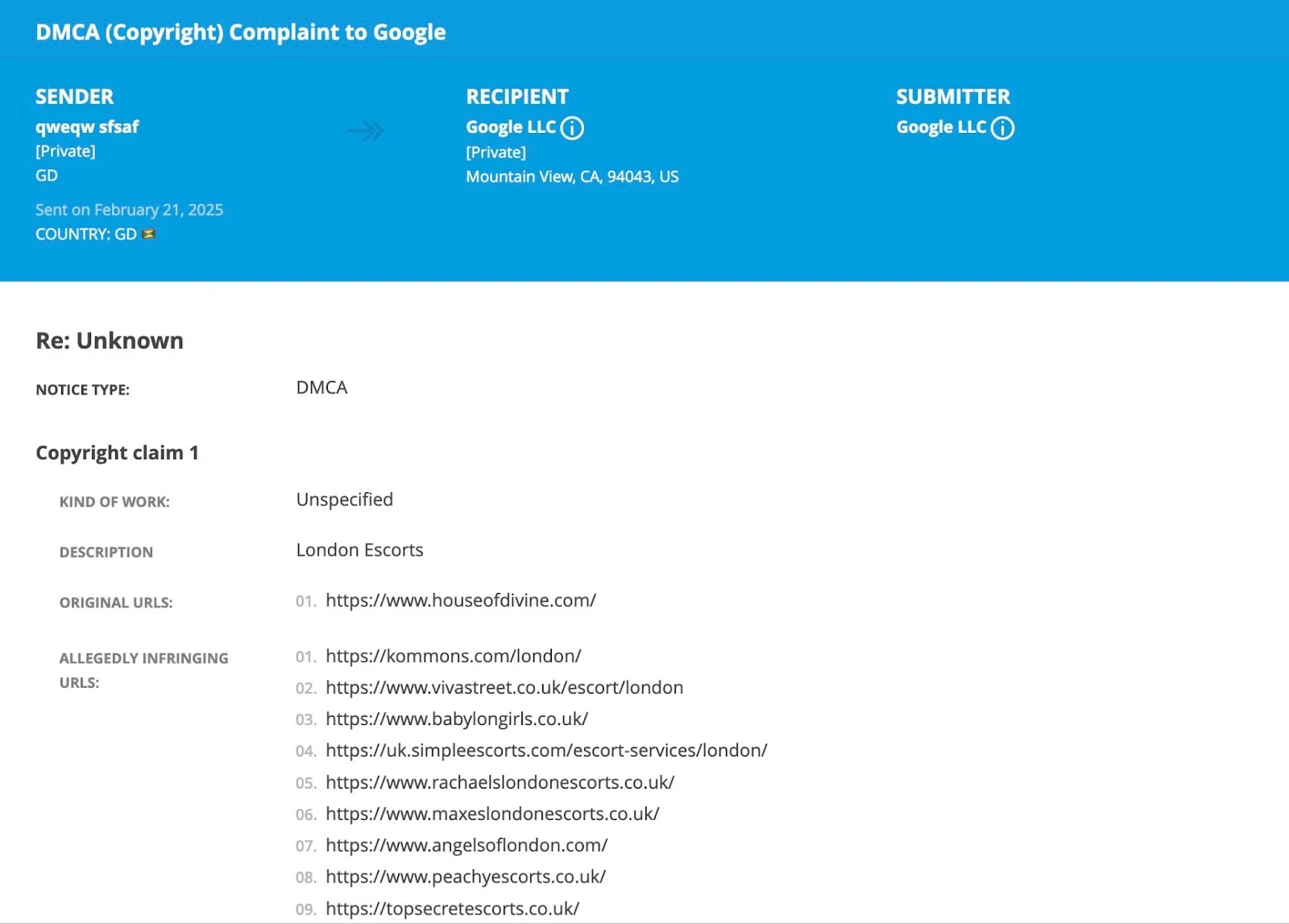
Google also says it notifies owners registered with Search Console. It adds that, for Search, meaningful notice to website owners is extremely difficult.
Test the notice
A takedown notice to a service provider, such as Google, must substantially include six things under 17 U.S.C. 512(c)(3)(A). Check the record against each.
| Required part | What to check |
|---|---|
| Signature | A physical or electronic signature of a person with authority to act for the owner. |
| The work | Identification of the copyrighted work. A representative list can cover several works on one site. |
| The material | Identification of the material claimed to infringe, with enough information to find it. |
| Contact details | Information the provider can use to contact the sender. |
| Good faith | A statement of good faith belief that the owner, its agent or the law has not authorised the use. |
| Accuracy and authority | A statement that the information is accurate. Under penalty of perjury, a statement that the sender has authority to act for the owner. |
The perjury wording attaches to the sender’s authority to act for the owner. Where a notice names no work and shows no evidence of ownership, we go back to the sender. That is our practice on sites we host.
Test your own side too. Check each listed URL for any image or text you did not make and hold no licence for.
If the notice fails the test, ask the sender to retract it. Google’s Legal Help page says many users contact the complainant directly to seek a retraction before they appeal. Google says it will assess retractions and restore the removed content where appropriate. It considers a retraction only if the original complainant submits it.
Because Lumen removes certain personal information, the record may give you no way to reach the sender. If you cannot reach the sender, or they refuse, the formal route for Google Search is a counter notice.
What a counter notice costs you
| What you give | What follows |
|---|---|
| Your name, address and telephone number | The statute makes all three part of your counter notice. Google says it will evaluate the counter notice and, if appropriate, forward it to the complainant. We treat that as a serious thing to sign if you work under a professional name. |
| Consent to a US court | With a non-US address, you consent to “any judicial district in which the service provider may be found”. You also accept service of process from the sender. The sender can then sue you in a US federal court. |
| A statement under penalty of perjury | You state that you believe in good faith that mistake or misidentification caused the removal. A knowingly false counter notice carries the same liability for damages and costs as a knowingly false takedown notice. |
| Time | The statute sets a window for hosted material of 10 to 14 business days after receipt. A provider that wants protection from claims by its user must put the material back in that window. The provider need not do so if the sender first notifies it of a court action to restrain you. |
Google’s Legal Help page gives its own condition. Google starts its 10-business-day window when it forwards your counter notice to the complainant. It says it will restore your content if the complainant starts no legal proceedings within that window. The content must also comply with Google’s other policies. The page warns that filing a counter notice may lead the complainant to start legal proceedings against you.
Reinstatement puts a URL back in Google’s results. Google’s help pages do not say a reinstated URL returns to the position it held.
What a counter notice must contain
Under 17 U.S.C. 512(g)(3), a counter notice must be in writing. Besides the items in the costs table above, it must substantially include:
- Your physical or electronic signature.
- Identification of the removed material, and where it appeared before removal.
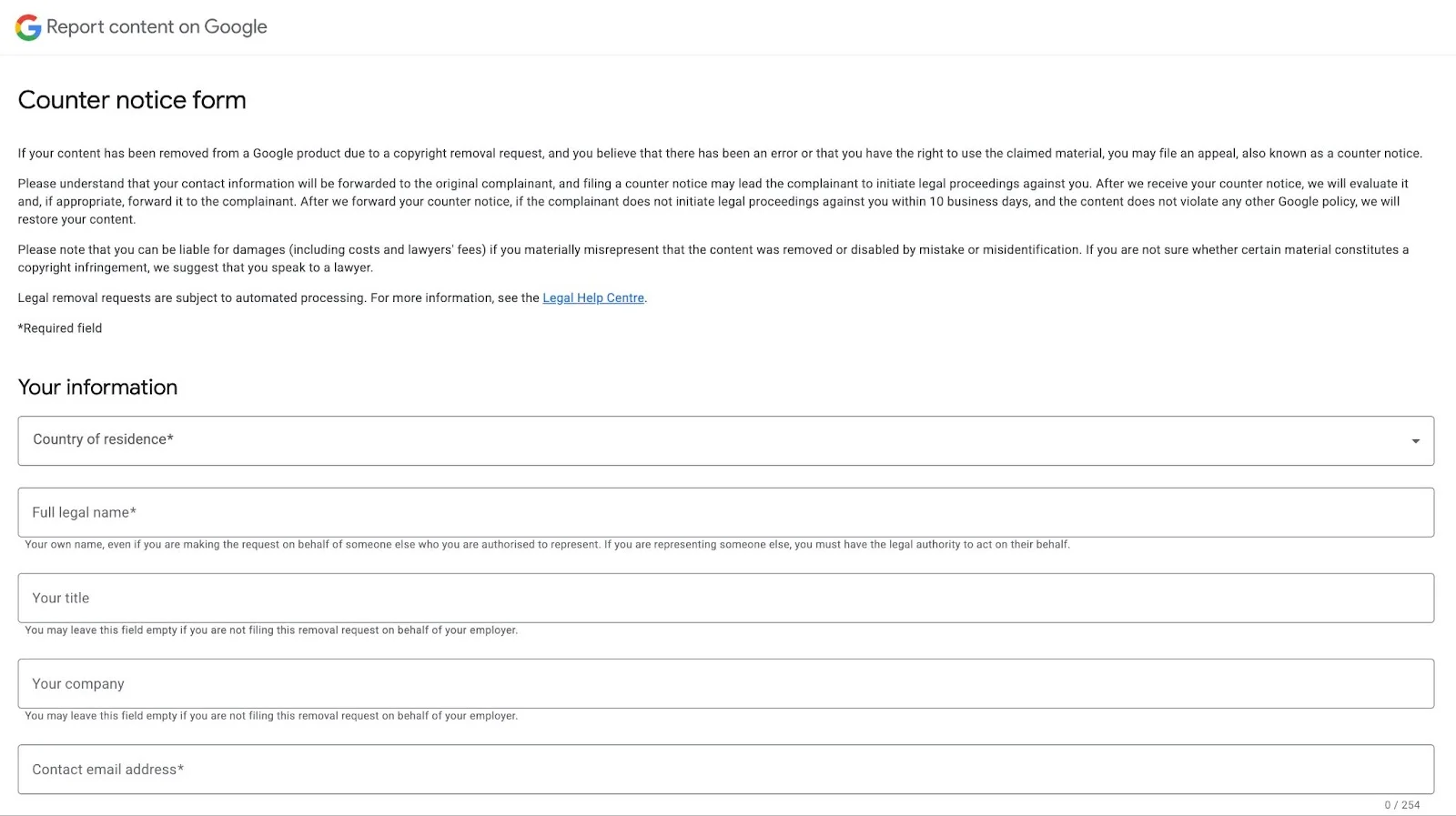
For Google Search, file through Google’s counter notice form. It needs a Google sign-in and asks for your full legal name. For a non-US address, the form specifies the US Federal District Court for the Northern District of California.
Suing the sender
Section 512(f) makes a person who knowingly and materially misrepresents infringement liable for damages and costs. It applies only where a provider relied on the claim and acted. These claims are hard to win.
The Ninth Circuit’s decision in Lenz v. Universal Music tests what the sender actually believed. It does not ask whether that belief was reasonable. The court also sets a two-part test for wilful blindness. The sender must believe there is a high probability of fair use. They must also take deliberate steps to avoid learning of it.
Keep your evidence, and watch for the next notice
UK copyright arises automatically, and the UK keeps no register of copyright works. Your proof of ownership is your own records. Copyright in a photograph normally sits with whoever took it. For a photo taken in the course of employment, the employer is normally the first owner. An agreement can change that. A freelance photographer usually keeps it unless they assigned it to you in writing. Keep those assignments with your files.
Our Malicious Link & Brand Monitoring watches for suspicious links and malicious tactics such as false DMCA removals. It sits in our Tier 3 Market Dominance plan. Our guide to recovering from negative SEO attacks covers what to do about hostile links.
Not sure what the notice means for you? Ask us and we will tell you straight.
Keep up with the latest in adult marketing
Genuinely useful tips, tricks and news that will impact your adult business.
No generic rubbish that you already know! We hate spam as much as you.
By submitting this form, you agree to allow HauteLab to store and process the data that you have provided in accordance with our privacy policy.

We Help Ambitious Adult Brands Launch, Grow & Thrive.
At HauteLab, we have built a unique, systemised approach to marketing, design, and development for businesses in the luxury adult niche. Providing you with a one-stop solution to launch, market and maintain your project.
Let's talk